

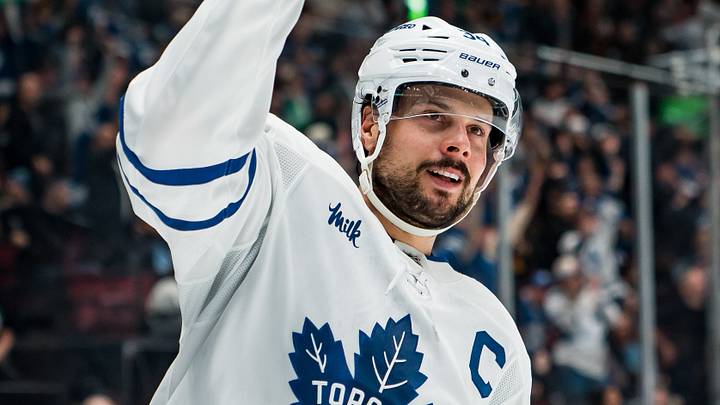
As training camp draws closer, questions are beginning to surface regarding what we can expect from the Toronto Maple Leafs in 2026-27.
Like with any team, the Leafs’ season could go either way. It could culminate in a Stanley Cup championship or end in another bottom-five finish.
The season outlook is essentially in a quantum state where it’s simultaneously a failure and a success. And we won’t know the precise outcome until the season is actually over. Despite the philosophical angles to this situation, Maple Leafs fans have plenty of reason to be bullish about the team.
Unlike other seasons, the Leafs have truly pulled off a retool on the fly. This wasn’t the old strategy in which Toronto just added around the fringes while keeping the top-heavy structure in place.
John Chayka tried his best to pull off a meaningful revamping without fundamentally changing the team’s core. The biggest changes happened in the crease and in the bottom-six forward group. While you could argue that they were changes around the edges, the fact is that Chayka changed precisely what he could.
Trading Auston Matthews and William Nylander wasn’t really going to be feasible. So, he attacked the portion of the lineup that he could. That’s why adding depth pieces to support Matthews and company became the primary objective this offseason.
Are Maple Leafs truly better than last season?
So, many fans have been asking: Are the Maple Leafs really better this season as compared to last?
On paper, that’s a resounding yes. The Leafs are better simply because they figure to be a much deeper team compared to last season. While that depth may not necessarily translate into a ton of secondary scoring, it will help cut down on the inclination to get outplayed and outworked.
Most importantly, the additional depth helps support Matthews, Nylander, and Tavares. The main purpose is to take some of the pressure off, potentially cutting down on Matthews and Nylander’s ice time.
One of the main issues during the Craig Berube administration was deploying Matthews in defensive situations. Yes, Matthews is a very good defensive center. But there were situations in which a third-line shift would have been much more conducive to success. Leaving Matthews on the bench for an offensive-zone faceoff would have been the better call.
Partially, that was due to the fact that former GM Brad Treliving did not give Berube nearly as much depth to work with.
But the outcome was also the result of Berube’s desire to transform the once high-flying, high-octane Maple Leafs into a grinding, defense-first club.
What could be a realistic outcome for Toronto in 2026-27?
It’s easy to start planning the Stanley Cup parade route. It’s tempting to say that Sergei Bobrovsky will shake off last season and return to his lights-out form.
It’s very easy to think that Matthews can get back to 60 goals while Nylander hits 100 points. Heck, why not even assume that Gavin McKenna can go on a rampage and score 40 goals like Matthews did over a decade ago?
But realistically, the Maple Leafs should be a solid playoff contender. They should be in the mix for a postseason berth all season long. That’s what some hockey odds are showing at the moment. Most bookmakers are bullish on the Leafs getting back into the postseason.
It will be in the postseason that all bets will be off. Depending on where the Maple Leafs end the season and depending on their playoff path, the Leafs could be on a path to make a deep playoff run or sink in the first round.
Ideally, the Maple Leafs would be a team that could take on all comers. That would be the perfect scenario. It’s worth keeping in mind that the Leafs will be a work in progress for much of the season.
That’s why fans shouldn’t be surprised to find the club struggling to find an identity in the early going. The hope is that they find it at the right time.
Game odds refresh periodically and are subject to change.
 Add us as a preferred source on Google