

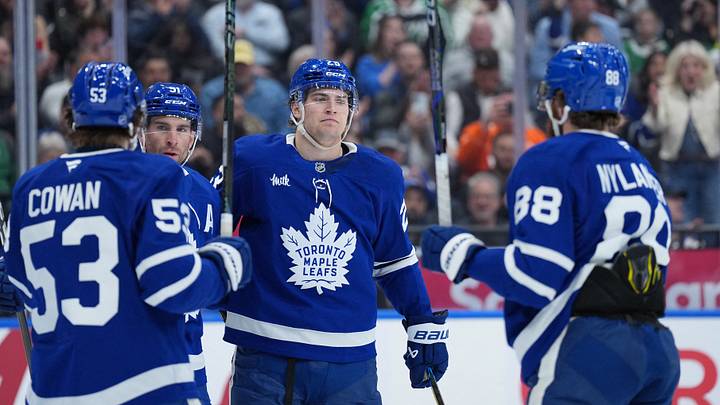
Under the new leadership of John Chayka and Mats Sundin, the Toronto Maple Leafs will look vastly unfamiliar in 2026-27. Based on the team's offseason acquisitions, one area in particular is sure to look very different from recent years.
In December of 2025, a league-worst Maple Leafs power play cost assistant coach Marc Savard his job. Steve Sullivan, the Toronto Marlies head coach for 2026-27, joined Toronto's bench for the rest of the year. He helped the Leafs improve their man-advantage play to a respectable 15th by season's end.
It was, however, the fourth consecutive year the Maple Leafs' power-play ranking had dropped since finishing atop the NHL in 2021-22 at 27.3%. During the Auston Matthews-William Nylander era, the Leafs have finished with a top-ten power play in eight of ten seasons and were a top-two unit four times. Personnel additions by Chayka and Sundin show their determination to bring back a major Leafs' weapon, albeit with a dramatic shift in strategy.
Why Offseason Changes Will Force a Strategic Shift to Leafs Power Play
The first major change to the Maple Leafs' power play is Darren Raddysh. Chayka's proactive sign-and-trade for the hard-shooting defenseman gives Toronto a new look with the man advantage. They have a threatening point-shot to pair with Matthews for the first time in his career. In 2025-26 with the Tampa Bay Lightning, Raddysh scored ten of his 22 goals on the power play.
Leafs' coach Jim Hiller will have some tough decisions to make with his power-play personnel. Matthews, Nylander, and Raddysh are givens on the first unit, but only two spots remain for flashy, playmaking first-overall pick Gavin McKenna, John Tavares, and Matthew Knies. McKenna will have to earn his stripes, but before long, his playmaking ability needs to be paired with the Matthews-Nylander-Raddysh trio.
On the depth charts of Daily Faceoff and PuckPedia, Tavares is currently listed on the first unit with McKenna on the second, but Hiller and his staff will have final say. At some point, one of Tavares or Knies will be bumped to the second unit. Both are great in front of the net, but a deciding factor might be Tavares' ability to win face-offs.
A player like Tavares or Knies playing on the team's second power-play unit provides better depth. Also, long-time first-unit member Morgan Rielly will now be with the second group. The Maple Leafs also added Jack Roslovic this offseason. He scored six power-play goals with the Edmonton Oilers in 2025-26. Defenseman Oliver Ekman-Larsson and forward Easton Cowan figure to be the other members of the second unit.
The trickle-down effect now gives Hiller and new assistant coach Daniel Alfredsson, who is expected to play a significant role with the power play, options. The Leafs should no longer have their first unit out on the ice for all but the last 20 to 30 seconds of the man advantage. They have capable players on the second unit.
The improved personnel should also strike up some internal competition for ice time on the first unit. McKenna, Tavares, and Knies can be interchanged if one of them is slumping or not performing as expected. Having one of them plus players like Cowan, Roslovic, and the Rielly-Larsson defense pair should make the second unit more dangerous.
One of the mandates of the new Chayka-Sundin front office was to return the team's power play to its previous dominant form. It's a needed tool for the Maple Leafs to return to the playoffs. Leafs' management has done its part to boost the team's power-play production. Now, it's up to the players and coaches to perform.
 Add us as a preferred source on Google