

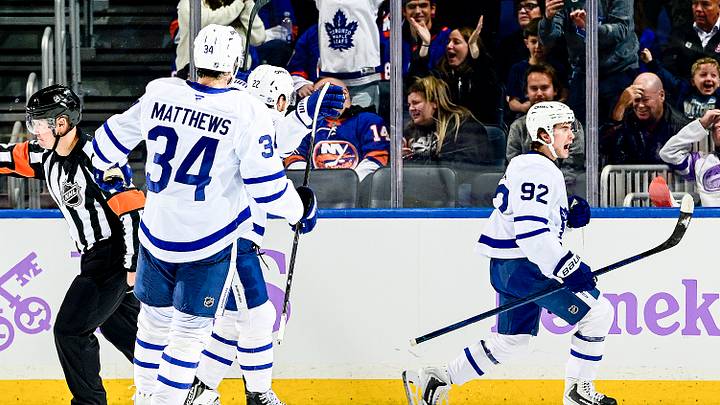
The hopelessness and lack of identity were felt viscerally through the first twenty minutes of the Maple Leafs' 4-2 victory over the New York Islanders. The foot speed, or lack thereof, and decision paralysis early in the game were evident and continue to raise concerns about the trajectory of this team in the short term. It ended up being a night worth celebrating for Leafs fans. Or maybe a communal sigh of relief is more accurate.
One of the quarrels Brian Hayes noted on an episode of Over Drive on November 18th, after the Leafs' seventh straight loss to the Chicago Blackhawks, was that the Leafs keep finding new ways to mismanage assets and curb the difficult process of establishing a firm identity and vision. During his heated, passionate soliloquy, Hayes' most poignant quote highlighted an ongoing feeling of desperation within the organization. When citing his fandom for the better part of three decades, through different ownership and management, he identified the one common thread among all leadership as, “A cycle of desperation, a reach for quick fixes, and this idea that you’re going to cut corners and live in a fishbowl that exists for only 365 days.”
"This team operates with desperation every season." 👀
— OverDrive (@OverDrive1050) November 18, 2026
Hayes goes on an epic outburst on the Maple Leafs' major issues.#Leafs pic.twitter.com/x4P2Ll81Tm
There's something to be said for Hayes' analysis of desperation in this franchise, and as fans of a team starving for another trip to the Stanley Cup Final, it's understandable to get caught up in the mindset of mortgaging your future to improve the current roster at any given cost. And it isn't always an unreasonable one, either. But when bad deals start piling up, and assets vanish into thin air, it begins to take a toll on the high-level prospects you can mould into your franchise.
The crux of the Maple Leafs' desperation stems from the franchise's lack of identity and its processes of building legitimate Cup-contending teams.
It was apparent in this most recent contending window. The narratives and issues that have plagued the Leafs centred on their lack of defensive identity, the 'pond hockey' offence they ran that never seemed to translate to the playoffs, and the lack of killer instinct in their core players. All of those issues can be pointed to a lack of strong leadership and giving players complete reign to play as they will–Nylander's poor defensive play continues to highlight the lapses he has never been challenged on. And how can you blame the franchise? Owned by conglomerates and non-hockey people, the team's direction year after year is simply to 'contend.' In theory, that's a great tool if you're into manifestation, but a philosophy needs habit and direction to come to fruition, and it needs to be instilled for the betterment of the franchise as a whole, not just for the roster at hand.
Lou Lamoriello and Mike Babcock were a far cry from Kyle Dubas and Sheldon Keefe in both philosophy and X's and O's. When the "old school" way of doing business stops yielding the results you want, they pivot to a new analytical way of team building, and when that stops working, it's back to guys like Treliving and Berube, back to doing business on wired telephones and bag skates after losses. Here we are again, in another data-driven era, and people are now calling for the likes of John Torterella to flip the script once more. With a marketing executive at the helm of MLSE, calling the shots on the direction this team should take, it's no wonder there's a sense that money comes first and difficult conversations get swept under the rug.
The Shanahan era, for all its disappointments, felt like it had open communication, preached patience, and built from the ground up. The brand of hockey didn't materialize in the postseason as everyone had hoped, and to Dubas' credit, he tried to address that by bringing in hard-nosed, established hockey guys like Jake Muzzin, Jake McCabe, Ryan O'Reilly, Nick Foligno and Mark Giordano. The cost? Mortgaging a combined four 1st-round draft picks and another nine total picks, with six landing in the second and third rounds. The current Leafs roster is now paying for those sins. And Jake McCabe is the only man left standing in all those deals; that doesn't even include the two firsts we've sent out in the next two years for guys who are no longer here. The Leafs have forfeited so much of their future that it feels like what we're left with is all we have to look forward to for the foreseeable future.
We're at a boiling point with this roster, and there's already talk about what the future holds for cornerstones Auston Matthews and William Nylander. Fans are pleading for reinforcements, but their lack of assets and the no-movement clauses littering this roster make any significant deals impossible to envision or execute. So, what can we expect?
On one hand, Marchenko's return gives everyone reason to be hopeful. The Leafs looked like a much different team with him in the lineup, and he's on pace for a point-per-game season and will see time alongside Matthews to continue reinforcing what has been a very dangerous first line. This team seems to perform better in front of Stolarz, and if he stays healthy and takes more starts than originally planned, some of these early losses could be recouped in the short term. McKenna is growing with every game, and if Hiller is willing to extend that leash, it isn't out of the realm of possibility that we see him reach the 20-goal and 60-point mark, giving the Leafs another bona fide top-6 forward for the remainder of the season.
On the other hand, the defensive core is old, slow, and breaking down every week–not just schematically, but physically, too. It's been the largest eyesore short of Bobrovsky's Revelation-like play. Jim Hiller doesn't exactly exude certainty and confidence. Between the constant line shuffling–even when they're winning–and the obvious fabrication of answers when asked difficult questions–we all know he's punishing Nylander and not trying to make the second power-play unit stronger. A head coach, much like the head of management, is supposed to embody the team's philosophy and direction. Through the first third of the season, Hiller has told us he's a guy with a plan, but he's gun-shy about deviating from it when it's obvious he needs to, and his time in front of the media is, at times, like his team's play on the ice: drab.
 Add us as a preferred source on Google