

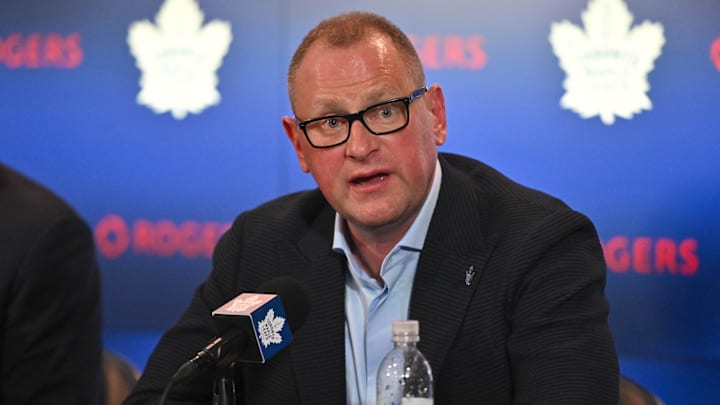
Toronto Maple Leafs fans should be glad that GM Brad Treliving didn’t panic and try to land Quinn Hughes from the Vancouver Canucks.
To explain my point, I’ll need to dip into my economics background. The hype surrounding the Quinn Hughes sweepstakes was something former Fed Chairman Alan Greenspan called “irrational exuberance.” In other words, the teams interested in landing Hughes were willing to pony up, regardless of the cost.
As the prevailing chatter states, some teams backed off because there were no guarantees Hughes would come with a contract extension. The Minnesota Wild, however, succumbed to the irrational exuberance.
Think about it this way: It’s like when investors piled into Bitcoin when it first hit $50K. The more investors piled in, the more the price went up. Many thought the bubble would never burst. But it did. Some were wiped out entirely. That was a case of getting in at the top.
That’s what the Wild did. They got in at the top. They bought Quinn Hughes when his price was at its peak.
Now, if the Wild win a Stanley Cup, it won’t matter. The price they paid to get Hughes and win a Cup would be worth it.
But what happens if they don’t? What happens if the Wild run into the superior Dallas Stars in the first round and go bye-bye? That irrational exuberance will be met with the same scrutiny investors faced when they poured into any stock that had .com after it.
Now, there’s a difference, of course. Quinn Hughes isn’t some fringe tech stock nobody’s heard of. He’s one of the top two defensemen in the NHL. But the price the Wild paid for zero guarantees is tough to stomach. It’s not like the Edmonton Oilers adding Hughes. They pushed the Panthers to Game 7 in 2024 and came up short again in 2025. You would think that adding Hughes would push them over the top.
But that’s not the Wild’s case. And it certainly isn’t the Maple Leafs’ case. Imagine if Brad Treliving had panicked and offered Matthew Knies, Easton Cowan, and a first-round draft pick, plus say, Morgan Rielly?
Would that have instantly made the Maple Leafs Stanley Cup contenders? There are some who might believe so. But Hughes wouldn’t have solved the Maple Leafs’ lack of scoring and dubious defensive play.
Would Hughes have avoided the awful game the Maple Leafs played on Saturday night?
When looking at things from that perspective, Maple Leafs fans should be happy that Brad Treliving didn’t make a deal for the sake of making one. Perhaps he called the Canucks and found out there was no way he could pull it off. If that was the case, good for him. He didn’t fall prey to the hype. Treliving was fortunate to avoid the fear of missing out.
Thinking a few steps ahead, the Maple Leafs have a chance to buy when there’s a pullback or a “correction.” Hughes will more than likely go to market in 2027. And if he does, the entire NHL will scramble to make its best offers.
Could the Maple Leafs be in a position to sign Hughes in 2027? It may be wishful thinking, but who knows? The Maple Leafs could be in a much better position next year than this season. And who wouldn’t want to win on the NHL’s biggest stage? There are only two or three teams that could offer that in today’s NHL.
The Maple Leafs are one of them. So, it could be that the Maple Leafs made one of the savviest moves in team history by making no move at all.
 Add us as a preferred source on Google