

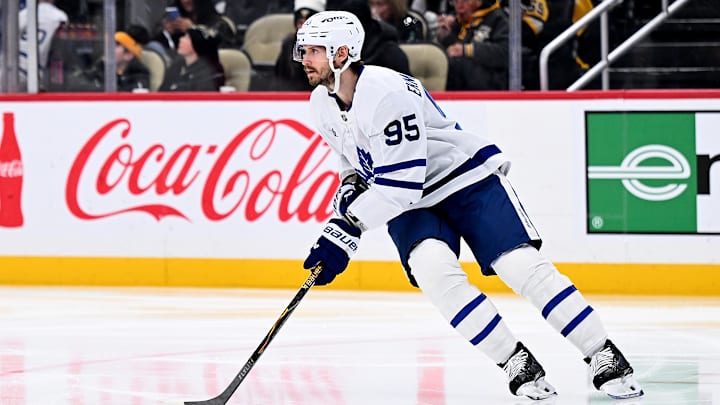
Losing Oliver Ekman-Larsson is a significant setback for the Toronto Maple Leafs. He exited Thursday’s game against the San Jose Sharks with a lower-body injury and did not return. Head coach Craig Berube confirmed the team will re-evaluate him, but there’s no clear timeline for his return yet. Ekman-Larsson has been one of Toronto’s most relied-on defensemen, often playing big minutes and contributing offensively. With other key defenders already sidelined, the Leafs must adjust quickly to stay competitive.
Lean on Morgan Rielly and Jake McCabe early and often
Without Ekman-Larsson, Morgan Rielly must carry even more of the workload. Rielly already sees top-pair minutes and drives a lot of the Leafs’ transition game. His ability to move the puck and break pressure will be crucial in limiting extended defensive zone time.
Jake McCabe, if he’s available, also becomes essential. McCabe has missed time due to an upper-body injury but remains a steady presence on the blue line. The Leafs need both veterans handling tougher minutes and managing matchups against the league’s top forwards. Consistency from Rielly and McCabe will help offset OEL’s absence on both the power play and penalty kill.
Get better depth contributions from the bottom pair
This season’s injuries have already tested Toronto’s depth. With Ekman-Larsson out, the Leafs must lean on defenders like Philippe Myers, Dakota Mermis (if healthy), and Henry Thrun. These players don’t need to be offensive catalysts. Their job is simple: make clean breakout passes, limit turnovers, and stay physical in their own end.
Berube’s system thrives on structure and smart, low-risk decisions. Depth defensemen must play error-free hockey, hold their positioning, and avoid risky passes that lead to odd-man rushes. If the bottom pair can handle these responsibilities, it eases pressure on the top four and keeps the team stable.
Forwards must help in transition and defensive support
Without Ekman-Larsson’s mobility and physicality, the forwards must chip in more on the defensive side. Auston Matthews, William Nylander, John Tavares, and Matthew Knies need to backcheck hard, support the puck carriers, and limit time and space for opposing defenders. Quick transitions out of the defensive zone will be key to preventing extended pressure and helping the blue line recover.
Winning puck battles along the wall and winning foot races to loose pucks will reduce strain on Toronto’s defence. When the forwards simplify their game and win possession battles, it frees up the defence to focus more on structure and less on scrambling to recover.
Goalie stability Is more important than ever
With top defenders out, goaltending performance becomes even more critical. Joseph Woll is expected to miss roughly a week with a lower-body injury, while Anthony Stolarz remains sidelined, and Dennis Hildeby has seen NHL action recently. Hildeby and other depth netminders must make saves that give the Leafs a chance when the defence gets stretched.
Strong goaltending helps mask defensive lapses that may occur without Ekman-Larsson’s experience and positioning on the blue line.
Final thought: system over star
Ekman-Larsson’s injury is a blow, but the Leafs can absorb it if they tighten up their system. Strong defensive structure, contributions from depth players, active forwards in zone exits, and reliable goaltending will help Toronto stay competitive while searching for answers on the blue line.
 Add us as a preferred source on Google