

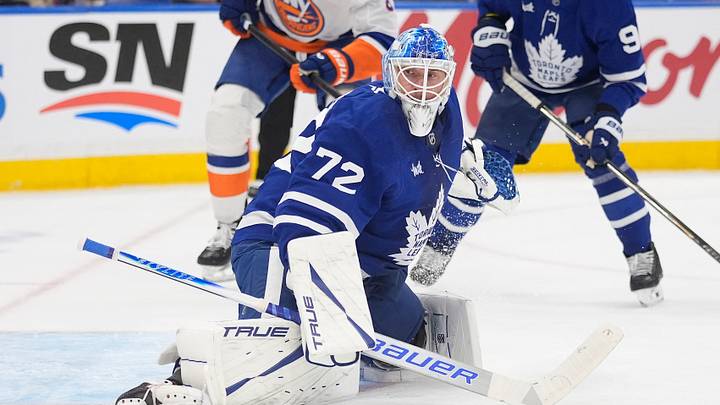
When it comes to goaltenders, there are elite goalies and everyone else.
Having been an elite goalie for more than a decade, Toronto Maple Leafs netminder Sergei Bobrovsky knows this better than anyone. The trouble is, with the netminder clearly struggling early on in the 2026-2027 season, there are clear signs that last season, the worst of his career, wasn't an anomaly. It may be the new norm.
That's a tough reality for a goalie whose resume speaks for itself. Beyond the back-to-back Stanley Cups he won with the Florida Panthers in 2024 and 2025, Bobrovsky owns an enviable trophy case. He is a two-time Vezina Trophy winner (2013 and 2017), a two-time NHL First All-Star Team selection (2013 and 2017), a Hart Trophy finalist in 2017 and a Vezina finalist again in 2024. Internationally, he backstopped Russia to World Championship gold in 2014, earning best goaltender honours, and added silver in 2015 and bronze in 2016. For more than a decade, he was a dominant force in the crease, with a body of work that should one day earn him a spot in the Hockey Hall of Fame.
At 38, Bobrovsky could be excused for losing a step. But he's an NHL goalie, on what many feel is hockey’s biggest stage in Toronto, so there’s nowhere to hide. Like all NHL netminders, he is facing shots that explode off the sticks of opposing forwards and demand impeccable reflexes. Few players perform at an elite level past their mid-30s. There are exceptions, but more players are out of the league by that age than are still in it, never mind thriving.
Science offers a clue to Bobrovsky’s struggles. Researchers separate reaction time into two types. Simple reaction time and Choice reaction time. Simple reaction time is responding to one signal with one known action, like hitting a button when a light comes on. Typically, this holds up well into middle age. Choice reaction time is different. It's the time it takes to read a situation, decide on the right response and then execute it, and it starts to slip much earlier. For a goalie, almost every save is a choice. Is the shooter going glove or blocker, high or low? Will that point shot get tipped? Is the pass going across the crease? Bobrovsky has to read the release, pick his save and get there, all in a fraction of a second.
That's where age may be catching up to him. Bob may not be any slower than he used to be; he may be later. The read is still there, but the decision and the push are arriving a beat behind. A split second is all it takes to turn a clean glove save into a rebound, and a rebound into a puck sitting behind him and the dreaded red light turning on. On a night when he gives up five goals on 17 shots, that split second might just be the whole story.
Maple Leafs might have made a mistake signing Bobrovsky
When the Florida Panthers let Bobrovsky walk this summer, you have to assume they did their due diligence. After seven seasons, including back-to-back Stanley Cups in which he was integral, no organization knows him better. Walking away from a fierce competitor who helped raise those banners couldn't have been easy, but the Panthers were confident it was time.
The numbers backed them up. Bobrovsky went 27-23-1 last season with a 3.07 GAA and .877 save percentage. For a goalie whose career numbers sit closer to a 2.62 GAA and .912 save percentage, it was a warning sign that the old Bob was likely gone.
Through 10 starts in Toronto, he's 3-5-2, allowing 33 goals on 288 shots. His 3.29 GAA and .885 save percentage are both the worst of his career. He's looked sharp on occasion, but his overall play is cause for concern, and with Bobrovsky signed for three seasons, the deal could become general manager John Chayka's first real misstep.
To be fair, a lot is new: a new city, new systems and a new defense in front of him. Chris Tanev, arguably Toronto's best and most stabilizing defenseman, has missed most of the season with an upper-body injury. One defenseman shouldn't sink a goalie with Bobrovsky's resume, but it matters.
Gone is the structure he enjoyed in Florida, a blue line built to suppress chances and a forward group whose elite forecheck limited shots and kept the puck out of his kitchen. Instead, he plays behind a team allowing 29.4 shots per game (seventh-worst this season), and a defense that, while capable on some nights, is prone to costly giveaways, lacks size and speed and has seen constant pairing changes since opening night.
From a fan's perspective, the message is clear: Bob needs to be better. Leafs Nation wants him to succeed, but patience is already wearing thin, especially after Wednesday night against Seattle, when he allowed five goals on 17 shots, including a game-winner with 32.7 seconds left that had no business getting past him.
So, where do the Maple Leafs go from here?
Truth be told, Toronto do not need the 2017 version of Bobrovsky to be successful. Despite all the criticism, Bobrovsky may not be as far gone as the numbers suggest. Heading into the game against the Seattle Kraken, his goals above expected was actually in the positive, putting him around the middle of the pack amongst NHL goalies. He wasn’t stealing games, but he wasn’t losing them on his own, either. If we are being fair, looking back, a lot of the goals that Bobrovsky has given up have come off the poor play of a injury-riddled leaky defense that is prone to giveways. If Maple Leafs head coach Jim Hiller can somehow fix the giveaways, settle in on his pairings and get his defense to clear the rebounds, Bobrovsky’s numbers will improve, accordingly.
With Anthony Stolarz emerging as the steadier of the two early on, Hiller might be tempted to start him over Bobrovsky in the long term. In my opinion, that would be a mistake.
The answer isn’t benching Bobrovsky, but it’s also not to ride him into the ground, either. Hiller needs to find a balance between the two netminders, a true 1A/1B split that leans towards whichever netminder is hot. This keeps Bobrovsky out of back-to-back games and limits his starts against the leagues most dangerous teams as he works on his game. The Leafs didn’t sign Bobrovsky to be a dominant force between the pipes, if they did they were delusional. They signed him to be fresh, confident and ready for late in the season when playoff races heat up en route to what Chayka hopes is a long playoff run.
If Hiller manages his netminders well, Bobrovsky still stands a chance at finding his game. Not the 2017 version of his game, rather a version that is suitable for this team with all of its impressive offensive power to succeed. But if you lean on Bobrovsky too hard, too early, then Chayka’s big goaltending gamble may be the one that defines him and not in a good way.
 Add us as a preferred source on Google