

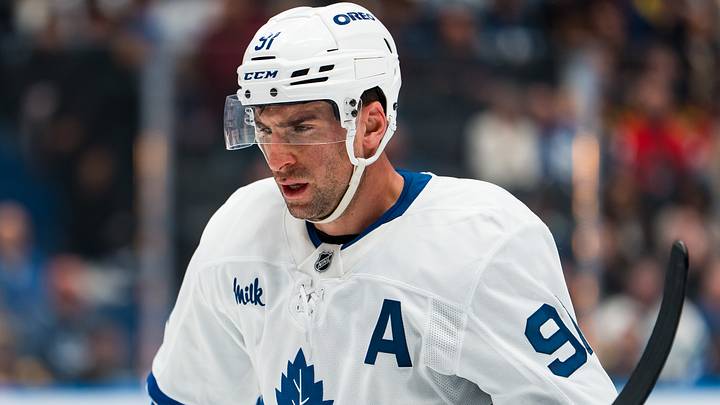
When John Tavares was last set to become an unrestricted free agent, he skipped the process entirely, signing a four-year, $17.52 million contract ($4.38 million AAV) to stay with the Toronto Maple Leafs.
At 34, home and family were seemingly the priority. Despite likely interest from teams willing to pay more, "JT" signed a hometown discount. He gave up a potential windfall (likely a three or four year deal in the $6 million range) for the "privilege" of staying a Leaf.
Now, with the team in a tailspin and likely headed for a rebuild rather than a retool, Leafs general manager John Chayka may approach Tavares with an offer he can't refuse.
The numbers don't lie
Tavares' role has been shifting, and not quietly. Friday afternoon, the Leafs had him penciled in as their second-line right winger, with rookie Gavin McKenna on the left and veteran Colton Sissons at centre.
Through 16 games, JT has four goals and six assists for 10 points. Five came on the power play, which means he has just five even-strength points. Verdict: not good enough.
The move to the wing lets him work along the wall, where he's still effective. He no longer has to cover large chunks of ice, where his lack of speed has been noticeably debilitating.
At 36, Tavares has to face the reality that his time as a viable second-line centre is likely over. He's still a valuable faceoff man (55.9% heading into Friday's game). He still has plenty of heart, and on occasion he can still snipe the odd goal. But his inability to cover down the middle makes him a liability most nights, as his minus-12 rating shows.
The burning question: will Tavares stay happy finishing the season as the team's second-line right winger? The bigger question: if the Leafs commit to a rebuild, would he waive his full no-movement clause to chase a Cup elsewhere? His protection shifts to a modified no-trade clause in 2027–28, so I suspect it's only a matter of time before he's moved.
With the right tact, Chayka can make a convincing case. Timing, destination and fit would be obvious accommodations: a short list of teams where JT has the final say, possibly close to home, on a club with a solid chance at a Cup right now.
Ottawa? The New York Rangers? Or how about Montreal?
The case for a John Tavares trade to the Canadiens
With the Canadiens' well-documented acquisition of Dylan Larkin to solidify their second-line centre position, the need for Tavares doesn't jump out at first glance. Montreal employs Nick Suzuki, Larkin and Phillip Danault as its 1-2-3 punch down the middle, with Oliver Kapanen centring the fourth line.
But imagine a lineup of Suzuki, Larkin, Tavares and Danault, or Tavares on the wing. He'd give them something they don't have in abundance: a veteran centre with a proven scoring touch (albeit not living up to expectations this season), playoff experience and leadership.
History suggests it's not impossible. Doug Gilmour, one of the most beloved Leafs of his era, eventually joined Montreal in 2001. Toronto traded Russ Courtnall to the Habs in 1988, and he became a productive Canadiens forward. Frank Mahovlich landed in Montreal after a stop in Detroit and won two more Cups. Vincent Damphousse went via Edmonton, won the Cup in 1993 and later captained the Canadiens.
Could Tavares reflect on past greats and accept a trade to the Bleu, Blanc et Rouge?
Montreal does have reasons to hesitate. Tavares' legs aren't what they once were, his scoring touch has diminished, and his $4.38 million cap hit runs two more seasons after this one. At 36, he isn't the long-term answer to anything in Montreal. The question is whether Montreal wants to invest in what Tavares can still offer, rather than worry about what he might lose.
If the Leafs sweeten the deal by retaining up to 50 percent of his salary, that might move the needle. Toronto wouldn't ask for a roster player, so Montreal keeps its depth, and depth is always key to a long playoff run. That's how you sell Tavares to Montreal: serviceable depth and insurance on a team that's close to winning. If the price is right, why wouldn't you roll the dice on a veteran who's hungry to win?
So, what's the deal?
The 2028 draft is said to be deep, so the Leafs could ask for a conditional 2028 pick. It would be a second-rounder that becomes a first if Montreal reaches the Stanley Cup Final and Tavares plays a set number of playoff games.
If Tavares helps deliver, Montreal won't care about the first. If he doesn't, all they've given up is a second-rounder, likely cashes in the 50th–64th range.
Sooner or later, Tavares will be on the move. Montreal makes as much sense as anywhere, and if the Leafs sell the playoff-depth angle, it could be a win-win for everyone involved.
 Add us as a preferred source on Google