

Through 20 games, the Toronto Maple Leafs are 8-10-2 to start the season and are in the midst of a four-game losing streak, with all four losses at Scotiabank Arena. They will take on the Minnesota Wild on Thursday and the Edmonton Oilers on Saturday to wrap up the six-game homestand.
To say it's been rough would be an understatement, and while it hasn't been this bad all season, and it will surely get better at some point, there has been concerning trends throughout.
Sergei Bobrovsky's slow start, their lack of depth defensively, and the never-ending injuries are all issues that have been highlighted. I could name more, but I think we all would agree those are the ones that stand out the most. Now, in an ideal world, all these problems are fixable, to a certain extent. Need another defenceman? Go out and get one. Need another goal scorer to add to the middle six?
The only problem is that, due to Toronto's salary cap, both this season and next, and the NHL's "tagging rules", it is almost impossible for the Leafs to do any of that.
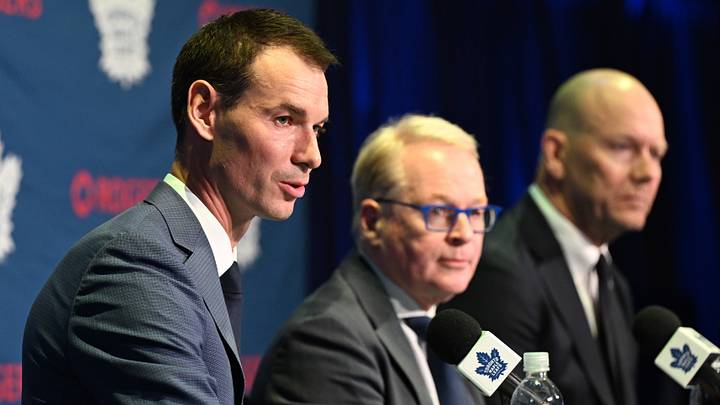
It appears that general manager John Chayka and his staff have mismanaged the salary cap, to the point where they have really handicapped what they can do this season. They aren't the first team to be up against the cap, but it's a little more complicated than that.
We all want them to make a move, and it's been well established that they have little to no assets when it comes to players or draft picks. But, as we look deeper, that's not their biggest problem.
Assessing the Maple Leafs' cap situation
The salary cap for this season is $104 million. Right now, according to PuckPedia, they have $2.45 million in cap space, thanks to the $10.12 million that is on long-term injured reserve (LTIR).
Next season, the salary cap is projected to be $113.50 million, and the Maple Leafs are projected to be at $111.98 million, giving them $1.52 million in projected cap space.
While they are certainly up against the cap this season, it's actually next season that is more important in the context of this conversation.
I will reiterate that this is all according to PuckPedia. I have seen in other places that they have even less room than the $2.45 million I mentioned above.
NHL's "tagging rules" have handicapped the Maple Leafs
Ok, so this is where things getting a little confusing. At least for me. There are tons of writers, analysts, and insiders who have a hard time describing the tagging rules, but I will do my best.
In simple terms, the NHL's tagging rules limit how much money a team can commit to the following season. Even if you're under the cap in 2026-27, you can't have whatever you want on the books for 2027-28 and just figure it out when the time comes. According to the offseason cap-accounting rules, next season's commitments cannot exceed the current salary cap plus 10%, which in this case would be the current cap of $104 million plus $10.4 million.
So, since the Leafs have $111.98 million on the books for 2027-28, that means that they cannot commit to more than $2.42 million more than that.
Let's use a tangible example. Calgary Flames defenceman Zach Whitecloud's name has floated around this season as someone the Leafs may want to add. Whitecloud makes $2.75 million this season and next. They don't, but let's pretend they had $3 million in space for this season. They wouldn't be able to trade just a draft pick for him, or a player from the AHL. His contract for next season would put them over the $114.4 million limit. To be clear, I'm not saying they should or should not get Whitecloud. It's just an example.
If they were to go out and get a player, if that player has term, it's not as simple as just making space for this season.
Does that make sense? I know. It doesn't really for me either, but I'm trying.
How did his happen?
So, how did this happen?
First off, Chayka and company added roughly $38 million towards the cap this season, and $45 million for 2027-28. Secondly, when they traded for Kirill Marchenko, they immediately extended him with a $12.5 million-per-season extension that kicks in next season. That was the final nail in the coffin that put them in this mess.
Former assistant Brandon Pridham was a cap master and took care of all of this stuff for the Maple Leafs for years. When Chayka was hired, Pridham was no longer a part of the program. People come, people go. That's fine. But it really does seem like he wasn't replaced, or at least wasn't replaced properly.
This all feels like an accident. Like Chayka and the rest of the management didn't fully understand what implications these contracts had beyond this season when it came to these tagging rules. This isn't as simple as being an expert in finances or accounting. This is all very complex and an expert is needed. Heck, I'm confusing myself just trying to explain it all.
Lack of assets is not the whole story for the Maple Leafs
By now, we all know that the Leafs don't have a lot of prospects, NHL players, or draft picks to use in bringing in reinforcements through the trade market. That's a problem, yes.
But this mismanagement of the salary cap may be a bigger issue. The fact that they don't have assets doesn't matter. They couldn't do anything even if they wanted to.
What that means is, to bring this back to the ice, is the players are going to have to be the ones to put this season back on the rails. The players need to dig deep and figure it out, because barring a miracle, or trading players like Morgan Rielly or even William Nylander, no one is coming in to save this team. All of that Nikita Kucherov talk? Forget it.
This is a big problem, and it's going to take a lot of brain power to work their way out of this one.
 Add us as a preferred source on Google