

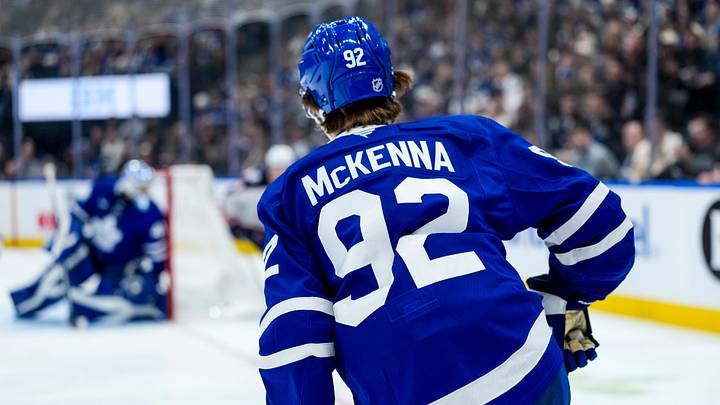
If you tuned into TSN for last night's highlights, you heard Toronto Maple Leafs head coach Jim Hiller explain why rookie forward Gavin McKenna didn't see the ice in overtime. To paraphrase, he said: "It's not something we've focused a lot on in practice. I'd like to get him some reps… he's gonna get out there eventually."
That answer has Leafs fans frustrated, to say the least, and likely McKenna and his teammates too. And the obvious question that comes with the frustration? If McKenna needs reps, why 28-games into the season, has he not received them? Is that not Hillers job, to ensure the kid gets reps?
With the team sitting seventh in the Atlantic and desperate for points, keeping McKenna off the ice in overtime can no longer be excused as an oversight. It's an act of stupidity.
Craig Button calls out Jim Hiller's use of Gavin McKenna
TSN's Craig Button didn't just call out Hiller. He also called out MLSE President and CEO Keith Pelley, who promised the Leafs would be a data-driven organization making evidence-based decisions. Button pointed out that, according to Sportlogiq, McKenna ranks fifth on the team with 6.67 expected goals. "You can't be two things at the same time," Button said, "data-driven and then not using data."
To Button's point: if you're a data-driven team, how do you ignore that number?
Colour me crazy, but a player with that data behind him should be playing in overtime. He should also have been on the ice late in the third, helping protect a razor-thin 2-1 lead, not stapled to the bench, getting just one shift in the final 13:42 after setting up Darren Raddysh's goal early in the period.
Despite the perception that the Leafs are an offensive juggernaut, this team has struggled to score. It averages just 3.11 goals per game, which ranks 17th in the league.
On the roster, McKenna ranks fifth in goals with seven and eighth in points with 17, good for 0.61 points per game.
His numbers won't strike fear into opponents, but McKenna is one of Toronto's key offensive weapons, and he's doing it on just 13:57 of ice time a night.
I understand the coaching argument. Three-on-three requires different decisions, particularly defensively. But here's the counterargument: what better environment is there for an offensively gifted player to showcase his creativity?
Three-on-three rewards:
- Puck handling in open ice
- Creativity and deception
- One-on-one offensive ability
- Quick decisions, vision and the ability to create passing lanes
- Drawing defenders in to open up teammates
Those are precisely the traits that make McKenna exciting and only serve to strengthen the argument that he should be out there for overtime!
He doesn't need to be the first player over the boards. Give him a controlled second shift alongside a responsible veteran centre and a mobile defenseman, and let him do what he does best: attack.
The reality is, the Leafs are not a defensively sound team, so sitting back and hoping to protect a late lead is a flawed plan. Toronto can't afford to leave offensive weapons on the bench they need to continue to drive play and make teams defend.
When a game reaches overtime, the objective isn't to reward experience or protect a young player's confidence. You already have the single point in the bag, so the objective should be to win. Period!
There's no guarantee McKenna would have won the game against Pittsburgh. But there's also no guarantee that the veteran combinations Toronto keeps using give it the best chance to do so.
At some point, you have to let your best offensive talent play. You have to give McKenna a chance.
 Add us as a preferred source on Google