

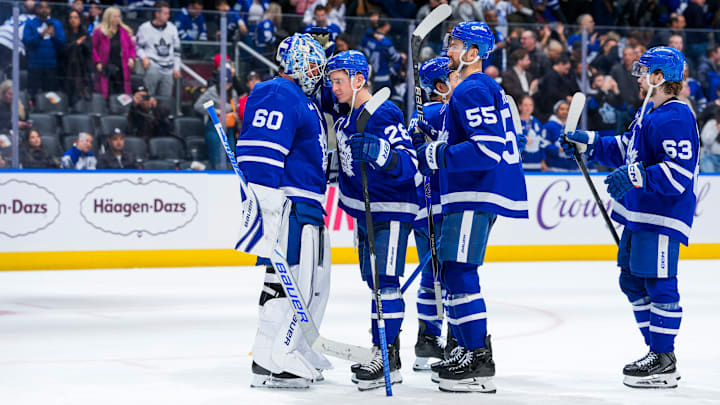
The Toronto Maple Leafs enter the Christmas break in a difficult position. They sit last in the Atlantic Division and second-last in the Eastern Conference. Despite how bleak that sounds, the margin is not insurmountable. Toronto is just five points out of a Wild Card spot and six points back of a divisional playoff position. A strong two-week stretch could quickly pull the Leafs back into the postseason conversation.
Changes already made
General manager Brad Treliving believes the season can still be salvaged, and the organization has already taken steps to spark change. Assistant coach Marc Savard was relieved of his duties, largely due to the Leafs owning the worst power play in the NHL. For a roster built around elite offensive talent, that simply was not sustainable.
Some positives have started to emerge. Nicolas Roy and Dakota Joshua are beginning to find chemistry, while Matias Maccelli has looked noticeably stronger since re-entering the lineup after being healthy scratched for much of December. Perhaps most importantly, the Leafs welcomed back Chris Tanev after missing 23 games with an upper-body injury, a return that immediately stabilizes an injury-riddled blue line.
The Maple Leafs' power play is an area that needs to get better, fast. Without a good special teams, it will be very hard to win games. Their power play can win them hockey games and keep them in games when they are not scoring five on five. The Maple Leafs problem is that they are not doing either, so it's almost impossible to win games unless your goaltenders only allow one goal a game. Special teams remain the most urgent issue. Without a functioning power play, winning becomes extremely difficult, especially when five-on-five scoring has also dried up. Toronto cannot rely on near-perfect goaltending every night just to stay competitive.
Stars must step up
That said, the Leafs must play significantly better going forward. What they showed before the break will not be enough to make the playoffs. Still, the pause may be exactly what this group needs both mentally and physically. A reset could help a team that has looked tight and disjointed find its rhythm again.
The Leafs’ stars must also elevate their play. William Nylander finally contributed offensively in Tuesday’s game, snapping a lengthy scoring drought. Auston Matthews, however, has not looked like the dominant force fans are used to seeing. His shot lacks its usual danger, and his production has dipped below superstar standards. John Tavares has shown signs of age, though flashes earlier in the season suggest he can still be effective in the right role. Matthew Knies also needs to respond. After earning his new contract, his play has trended downward, becoming increasingly quiet in recent weeks. He doesn’t need to carry the offence, but stronger, more consistent efforts are required—especially alongside elite linemates.
Ironically, the Leafs’ bottom six has been one of their strengths. Scott Laughton has looked rejuvenated and has provided reliable depth scoring and late-game minutes. That contribution must continue if Toronto hopes to climb the standings. Goaltending health will also be critical. Anthony Stolarz has been sidelined since November, and his absence has been noticeable. Stability in net could be the difference between a surge and another collapse.
What must improve after the break
Finally, Treliving may need to act. This roster, as currently constructed, is not a true Stanley Cup contender. A legitimate top-six winger is needed. Max Domi is not a long-term solution on the first line. The defence could also use another top-four option, especially with injuries continuing to test the group.
The path forward is clear but demanding. If the Maple Leafs want to save their season, it will require buy-in from everyone, from the stars to the depth players to the front office. The push begins after Christmas, and there’s little room left for excuses.
 Add us as a preferred source on Google