

As the pressure builds in Toronto, Brad Treliving is beginning to feel the heat. The Toronto Maple Leafs have underperformed for much of the season and stumbled into the stretch run on a brutal three-game skid since the National Hockey League schedule resumed after the Olympic break.
Now sitting well outside the playoff picture with the trade deadline fast approaching, scrutiny is intensifying on the front office. With expectations unmet and urgency mounting, the spotlight has shifted squarely onto Treliving to make the kind of decisive moves that can jolt a stagnant roster back to life, or risk seeing his long-term future in doubt.
Should Treliving not survive MLSE president and CEO Keith Pelley's post-mortem review of the Maple Leafs' failed season, there are three key decisions that will have played a factor in his demise.
Three Roster Bets That Have Shaped Toronto's Step Back
One of Treliving's first major bets as GM of the Maple Leafs came on the opening day of free agency during the summer of 2024. He signed defenseman Chris Tanev to a six-year, $27 million contract carrying a $4.5 million AAV.
The cap hit itself was never the sticking point; Tanev was a steady, right-shot defender who was coming off a galvanizing end-of-season run with the conference-contending Dallas Stars. Tanev built a reputation as a no-nonsense, rugged, shot-blocking, defensive menace. That style comes with wear and tear, so the real debate centered on the term of his deal. Committing long-term to someone of that age (34) and profile was a calculated risk.
During Year 1 of Tanev's contract, the Leafs reaped the benefits of his steady presence on the blue line. He was durable and effective, helping lead Toronto to the second-fewest five-on-five goals against in the NHL. The Maple Leafs were also top-ten in goals-against-per-game and won the Atlantic division before losing in the second round of the playoffs to the eventual Cup-champion Florida Panthers.
During the 2025-26 season, year two of the deal, Tanev's age and mileage have begun to show. Tanev has played in only 11 of 60 games thus far due to an upper-body injury and a severe groin injury, prompting the team to contemplate surgery.
Tanev has not yet reached the back end of this contract, but his age and mileage have started to show. Treliving's gamble and willingness to prioritize immediate defensive structure have been absorbed by long-term uncertainty. The Maple Leafs have been a disaster without Tanev, and there is still no clear resolution on his return.
The move that draws the most ire from Maple Leafs' fans, however, is Treliving's decision to trade for veteran defenseman Brandon Carlo at last year's trade deadline in an effort to fortify the blue line for a playoff push.
To acquire Carlo, Toronto parted with top prospect Fraser Minten, widely viewed, alongside Easton Cowan, as the organization's two most promising young forwards. The gamble was clear: sacrifice future upside for immediate defensive stability. Instead, the optics have turned harsh.
Minten has flourished in his first full NHL season with one of Toronto's Atlantic Division rivals (who they are coincidentally chasing for the final wild-card position), producing 14 goals and 29 points in 59 games while posting a plus-16 rating. Meanwhile, Carlo has been part of a Leafs defensive unit that has struggled mightily at five-on-five, surrendering more goals at even strength than any team in the league. What was intended as a win-now reinforcement increasingly looks like a disastrous miscalculation, one that cost Toronto a key piece of its future.
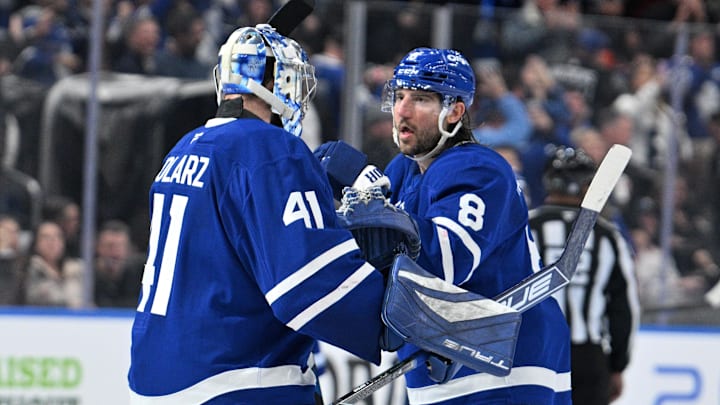
The final risky decision of Treliving's tenure came in goal. After signing Anthony Stolarz in free agency, the same summer he added Tanev, the Leafs' GM doubled down by handing the goaltender a four-year, $15 million extension ($3.75 million AAV) before the 2025-26 season began.
Stolarz's first season in Toronto showed promise, but it was also interrupted by injury, a warning sign that proved significant. Betting long-term on an aging (32) goalie with a limited track record as a full-time starter and durability concerns was a calculated gamble. So far, it has not paid off.
Stolarz has appeared in just eighteen games this season. He was sidelined for a large stretch with an upper-body injury, and when healthy, he has struggled to compensate for the team's defensive lapses, posting a .885 save percentage.
In a season where stability in net was essential, the commitment to Stolarz has instead amplified questions about roster construction and about whether Treliving misjudged the most critical position on the ice. The Maple Leafs have depth in goal; it's a position of strength, but Treliving has yet to sort out which of Stolarz, partner Joseph Woll, and prospect Dennis Hildeby the team should build around.
If MLSE president Pelley ultimately decides that a disappointing, playoff-less season warrants a change at the top, these three decisions are likely the ones that Treliving will regret most. Each move reflected a front-office strategy that prioritized immediate fixes over sustainable growth. Three choices that stand out as pivotal miscalculations in a season that has left both fans and management wanting more.
 Add us as a preferred source on Google